
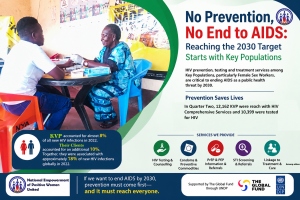
As the world works toward the 2030 target of ending AIDS as a public health threat, one message remains clear: without effective HIV prevention, ending AIDS will not be possible.
In South Sudan, the Global Fund-supported HIV response is helping bring essential HIV prevention and testing services closer to Key and Vulnerable Populations (KVP). Through support from the Global Fund, with UNDP as the Principal Recipient, the National Empowerment of Positive Women United (NEPWU) is implementing community-based interventions that take HIV services directly to people and communities where they are most needed.
Globally, KVP accounted for almost 8% of all new HIV infections in 2022, while clients of sex workers accounted for an additional 10%. Together, these groups were associated with approximately 18% of new HIV infections globally in 2022. These figures demonstrate why effective HIV prevention, testing and treatment services among KVP and their Clients are critical to achieving the global goal of ending AIDS by 2030.
Bringing HIV Prevention Closer to Communities
Through community outreach activities, NEPWU connects KVP with a range of essential HIV and health services, including HIV testing and counselling, SRH Services, GBV Refferal, Family Planning, condoms and Lubricants and other preventive commodities, information and referrals for PrEP and PEP, STI screening and referrals, and linkage to HIV treatment and care.
Bringing these services closer to communities helps address barriers that can prevent people from accessing health facilities. These barriers may include stigma and discrimination, distance, lack of information, and concerns about accessing services in conventional health facilities.
For many Key Populations, community-based services provide a more trusted and accessible entry point into the health system.
Testing Saves Lives
HIV testing remains an important entry point for prevention, treatment and care. People who test negative can be connected to appropriate prevention services, while those who test positive can be linked to treatment and care as early as possible.
In Quarter Two, 12,162 Key and Vulnerable Populations (KVPs) were reached with comprehensive HIV services, of whom 10,399 (85.5%) received HIV testing. This high level of testing coverage demonstrates the program’s effectiveness in expanding access to HIV services, promoting early diagnosis, facilitating timely linkage to treatment for those who test positive, and strengthening prevention interventions for those who test negative.
Early diagnosis and prompt linkage to treatment can improve the health and quality of life of people living with HIV. Effective treatment also reduces the amount of HIV in the body to an undetectable level, which prevents sexual transmission of HIV.
The Power of Community-Led Responses
Under The Global Fund, the contribution of Key and Vulnerable Population-led organizations such as NEPWU is particularly important in reaching communities that may otherwise be missed by conventional health services.
Peer educators play a central role in this effort. Because they understand the communities they serve, they are able to build trust, provide accurate information, encourage HIV testing, distribute prevention commodities, facilitate referrals and support clients in accessing treatment and other health services.
Their work demonstrates that HIV prevention is most effective when communities are not simply recipients of services but are actively involved in designing, delivering and strengthening the response.
South Sudan Cannot Leave Key Populations Behind
South Sudan cannot afford to leave Key Populations behind in the fight against HIV and AIDS. Every missed opportunity for HIV prevention, testing or treatment can contribute to continued transmission and make the 2030 goal more difficult to achieve.
Ending AIDS requires more than treatment alone. It requires sustained investment in HIV prevention, community-led services, HIV testing, condoms and other preventive commodities, PrEP, PEP, education, treatment and an enabling environment where everyone can access health services without fear of stigma or discrimination.
The path to ending AIDS by 2030 must include everyone. If we want to end AIDS by 2030, prevention must come first and prevention must reach everyone.
